Making it intentional

If there is one constant theme in everything I try to do in music, it is the idea of intentionality. I once read both John Cage’s books in praise of chance operations and ambient sounds, and found them highly entertaining, and even persuasive, but when the chips are down, I beg to differ.

One of the main problems confronting people learning improvising is knowing whether what they did is good or not. The first mental cage they need to break free from is the idea of correct or incorrect based on what notes are allowed. What is a right note and what is a wrong note? To answer that question, I like to quote Duke Ellington’s famous dictum: “If sounds good, it is good.” But this may not be enough for some students. They still want to know if you think it sounds good or not. And that is when you have to throw the ball back by saying, well, is it what you wanted to play? Did it come out the way you wanted it to?

Once we have settled that the best we can hope for in performance is to match the act to the intention, we can start organising our inner game to lining up those two variables. The pathway we need to build broadly follows the sequence: the idea is born; the idea takes shape; we hear the idea as sound; we play/sing the sound, possibly adjusting it as we go, to fit the idea as closely as possible. As we progess, we hone that process till it becomes seamless.

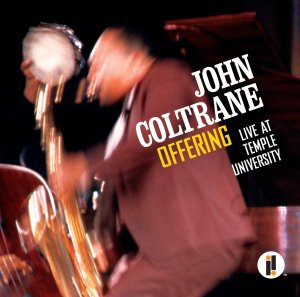
The level we want to reach as artists is not always the one we imagined as beginners on our journey. We might start by wanting to play like Michael Brecker, without knowing too much about how he found which notes to play. If after years of hard work we actually succeed in sounding like him, we didn’t find those notes the same way he did. We found them by listening to Michael Brecker. It is only when we have developed our own strength of hearing enough to turn it into sound, that we realize that all we needed from Mike was that initial push to set us on the path. Just as Mike was set on his path when he caught Coltrane live at Temple University on November 11th 1966.
temple

Follow me on Twitter @jazzpanflute

Posted in Musicianship | Tagged , , , , | Leave a comment

Six Seconds Make a Seventh

This post stirred up a hornet’s nest the first time I posted it. But just remember the adage: the map is NOT the territory. And if you’re planning a car trip, a subway map won’t help you. Likewise, music can be represented in whatever way best suits your needs or your project. And here the project is “learning to play like singing in the shower”.

Follow me on Twitter @jazzpanflute

jazzpanflute's avatarIntervallic Awareness for Improvisers

Six seconds make a seventh? Is time expanding? How do they do that? Simple! The same way as two thirds make a fifth! Two fifths make a ninth, but three of them make a thirteenth, which is also twelve seconds. Try this on your music teacher and watch him get his head around it.

Classical musical theory can’t multiply and refuses to add up. The terminology sucks too: “a fifth” is an interval, but “the fifth” is a note.

It doesn’t help that there are 31 notenames for twelve notes. You may want to hear how horrible that would sound if all 31 were allowed equal rights:

Image

In fact the only argument I ever hear in defense of this cock-eyed theoretical tradition is that it has been around longer than you and that’s what we are used to. Well I have to admit, I’m used to it too. But we…

View original post 127 more words

Posted in Music Theory | Tagged | Leave a comment

Intervallic improvising

When making analyses of great solos, jazz teachers like to look at the scales and arpeggios used and try to relate them to the underlying chord sequence. The operation consists of extracting all the notes in a passage and stringing them out in order of pitch. The ones you decide don’t belong to your scheme you call passing notes. So before you even begin your explanation of the passage you have already double-guessed what the player was thinking (assuming he was actually thinking).

Some of the theory behind this relies on making an artificial distinction between scales and arpeggios or chord tones. In classical times it was no problem: you simply bang out all the notes simultaneously, and if you like the sound, they form an arpeggio. If they sound horrible, that was a scale. But nowadays you have to know what you’re doing because some scales have less notes than some complex chords and people’s ears have got used to all sorts of stuff.

Coltrane’s solo on Resolution, a tune with echoes of Thelonious Monk’s Bemsha Swing, that forms part 2 of A Love Supreme, has straighforward passages in E-flat minor pentatonic spiced with some visits to unrelated major keys. But some of his coolest licks lend themselves more to MOVES analysis than to the traditional method. In the solo passage below, he interjects some +3 -4 moves that echo bars 22-23 of the theme. Same goes for the -6 moves that occurs throughout the solo, reminding us of the strange diminished feel of the piece. Note the ending of the phrase in both the theme and the solo (bars 23 and 128), a typical Trane rhythmic figure that everyone and his dog was playing by the end of the sixties and which still won’t go away.

resolution

Trane took this interest in intervals to extremes in later years, and some of his compositions make no sense at all if you search for a conventional octave-span scale. Track 2 of the Meditations album, Compassion, has a floating melody which I play on shakuhachi in the video below to the accompaniment of a London riot. The theme is a slow two-note figure spanning a -3 move (descending minor third) drifting wherever the fancy leads. In fact the whole album uses the kind of ideas you could write out on the back of an envelope using MOVES notation, and which lend themselves to analysis in terms of short scales.

You can find out more about MOVES on the MOVES page in the menu above.

Follow me on Twitter @jazzpanflute

Posted in Interval Training, Moves notation, Music Theory | Tagged , , , , , , , | 1 Comment

Ethiopian groove

Anyone interested in exotic scales should definitely listen to the Ethiopiques record collection, copiously shared on youTube. They were re-mastered from recordings rediscovered after being buried in the vaults during the 18 years of Ethiopia’s repressive Mengistu regime, which tried to ban everything Western, including saxophones and trumpets.

The familiar and less familiar pentatonic scales receive an eery modal treatment, delivered with an intense nervous vibrato much appreciated by fans of this music. Here are two examples of the less familiar scales, which I have heard nowhere else, though they might also be present somewhere in the vast repertoire of Indian music. Be that as it may, the flavour of these performances is quite unique to Ethiopia.

In the first piece I have transcribed a portion of the sax riffs, which keep to a { 3 3 1 4 1 } scale starting on E-flat. Used modally, without interpolated notes, this scale creates a very tense, passionate atmosphere.

For the second tune (the title means “You are sublime”) I have written out the opening guitar line. If you start from E, the scale resembles the Japanese { 1 4 2 1 4 } insen scale. The Ethiopian version however, treats A as the tonic, so that it becomes a sort of defective A minor scale (missing its fourth and seventh): { 2 1 4 1 4 } . Even accidentally hitting one of the “missing” notes spoils its special flavour.

MOVES notation can offer ideas for learning to find your way around any scale. Instead of representing numbers of halfsteps (semitones), we simply decide that each number will represent a number of intervals in the nominated scale. So the instruction {+1} simply tells us to go up to the next rung in the scale. The wiggly brackets tell us to keep looping that operation. So basically, it instructs us to play the scale ascending. My Shortcut to Improvising Fluency offers a variety of formulae to help you master any scale inside out. Naturally, these exercises will give different results depending on the number of tones in the scale. A loop like {+5 -4 } will give you a sequence of fourths rising in halfsteps in the chromatic scale { 1 }, the original MOVES default scale. Using the same notation on a heptatonic scale would give you a melodious series of sixths, while on a pentatonic it would yield a sequence of leaping octaves. So it is up to the player to decide whether the notation is diatonic (using the notes of a scale), or chromatic.

It all becomes clear in the book, if it isn’t already.

Follow me on Twitter @jazzpanflute
Posted in Moves notation, Scale Practice | Tagged , , , , , , , | Leave a comment

Playing Without Expectations

Once in a while I consult the I Ching, the Chinese Book of Changes. In fact this book was my original reason for deciding to learn Chinese way back when. Yesterday I drew the 25th hexagram, Wu Wang (无妄), a title which I see has been translated in a variety of ways including “Innocence”, “Conscious Innocence”, “The Unexpected”, “Without Embroiling”, “Without Entanglement”, “Without Expectations” and even “Acceptance”. In my French edition it comes out as “Spontanément”. I think “Without Guile” might be nearer the literal meaning, or in muso language “Without Ego”.

This hexagram offers a ton of food for thought for would-be improvising musicians. For anyone out there considering having the Chinese text tattooed on their persons (see some cautionary tales here), here it is:

无妄
元亨
利真
其匪正
有眚
不利有攸往

A rough translation gives: Without guile. Thoroughly auspicious. Perseverance pays. Where integrity is lacking there are pitfalls. It doesn’t pay to have a destination. In the fifth line, 有眚 you sheng literally means “there is a cataract” (in your eye), and by extension, the sort of slip-up you get when you can’t see where you’re going. But you could understand it as meaning you are blind to your own shortcomings.

The word I have translated as integrity, zheng, is also used in a musical context to mean “being in tune”. So the phrase could mean “When you’re out of tune, you are blind to it”. This can be taken at whatever metaphorical level you want. Being in tune is a spiritual state where you are fully aware of what’s going on around you, and you are free from neediness. For the performer this means you are not playing to earn approval or status, or as part of some agenda.

Confucius said if he had another lifetime he would use it to study this book. Composer John Cage claimed to have used it in his compositions, which you can find out more about here.

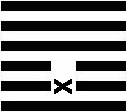
For improvisers of a more practical bent, the I Ching can be used to find random scales or rhythmic patterns. One method that I offer in my Shortcut to Improvising Fluency uses twelve squares arranged in six pairs. Each pair represents one of the six tubes making up an octave on a whole tone panpipe. The yang lines (7) represent the open note, the yin lines (8) the shaded notes a halfstep lower. A 9 give you both notes on that tube, and a 6 means skip that tube. Changing lines (6 and 9) are used to generate a descending scale. On this occasion I had a 6 in the second line (counting from the bottom).

hex25

This gives us a 3 3 2 2 2 scale ascending with a major second on the way down:

line2

In my book you can also find formulae for working any random scale in every which way. And for anyone in a hurry there is my random scale generator, which deep in its javascript bowels uses the same mathematics borrowed from the I Ching.

While practising the scale you can ponder the meaning of the text. And maybe I’ll get an appointment with the eye-doctor to check for cataracts. Who knows, the literal meaning may be the right one, after all.

Posted in Musicianship | Tagged , , , , , | Leave a comment

Working the Boogie Woogie scale

A while back I commented on some of the scales that have seen a lot of use in the past hundred years but don’t seem to have been incorporated into scale practice routines – yet. Maybe this is a good thing, I can’t say. But one person I could swear must have spent long hours taking the Czerny approach to working on oriental and blues scales is the late lamented Alice Coltrane, whose solos are some of the most underrated jewels of jazz of the 60’s. Anyone who says they are rambling needs to chill out and listen again.

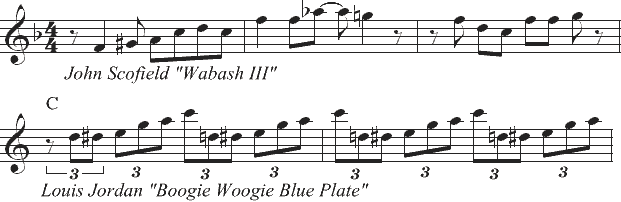
Here is another scale you must all be familiar with, though I don’t know if it even has a name. I’ll call it the Boogie Woogie Scale, but I stand to be corrected if someone knows its “official name”. There are two forms which I give below, with or without the D natural.

boogiewoogie

The second of these happens to be the first mode (or relative major) of the 3 2 1 1 3 2 minor Blues scale:

bluesScale1

So maybe we should call it the major Blues scale. Unlike its relative minor however, we tend to hear this as an ascending scale. If the gentle reader can find any examples of it descending I would be interested to hear from them. And likewise, I can’t think of an example of the minor Blues scale ascending all the way either. Which is why you will be more likely to see the note wedged between the two halfsteps spelt as a sharp in the major mode and as a flat in the minor version.

Here are two examples, showing both forms of the Boogie Woogie scale:

wabash

The first form (without the major second) appears in the second bridge or “trio” section of Egberto Gismonti’s frevo Karatê in a rollicking series of chromatically ascending chords at 1:02 in the video below. You may find it an eccentric way to harmonize the scales, but that’s all part of Gismonti’s game.

karate

If we write it out as an exercise in MOVES notation it comes out as:

{+1 +3 +1 +3 +2 +3 +1 -3 -2 -3 -1 -3} 

Don’t be mystified by the +1 move at the beginning. It’s there to chain up when you cycle back to the start. (It’s called a chaining move for those who want to use MOVES jargon). So that is one way to work this scale to death, but with the added bonus that you’ll end up halfway to being able to play the bridge of Egberto’s off-the-wall tune, which you can listen to here:

Follow me on Twitter @jazzpanflute

Posted in Scale Practice | Tagged , , , , , , , | Leave a comment

Charting the Emotions

Once upon a time, inspired by Alain Daniélou’s Ragas of North Indian Classical Music, I mapped just-tuned frequencies into an infinite web that I call the Honeycomb.

honeycomb1

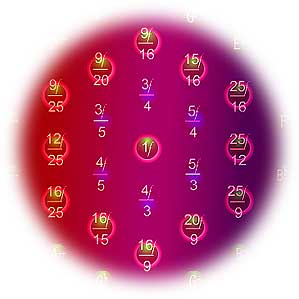
You can explore it in my interactive Atlas of Tonespace, by clicking on the notes to see the fractional relationships between them. Any note can sit at the centre of the diagram below and be surrounded its fractional kinsfolk in identical fashion:

fractions

Daniélou’s book attempts to chart the emotional nuances of the individual śrutis (microtonal variants) of Indian music. Students of Indian music learn these microtones subjectively, by summoning up the emotion itself. I mapped Daniélou’s fractions to the Honeycomb, revealing five complete chromatic sets offset from one another by śrutis. I have color-coded them into emotional “families”, ranging from red for frantic to blue for mournful. The slanting white line shows where Equal Temperament falls in the scheme.

shruti

Explorers like Charles Lucy have created recordings of some classical pieces performed with Just Tuning. Accustomed as I am to Equal Temperament, I find they sound, frankly, odd. So I didn’t imagine our standardized intervals would carry emotional charge in the same way as those in Indian music.

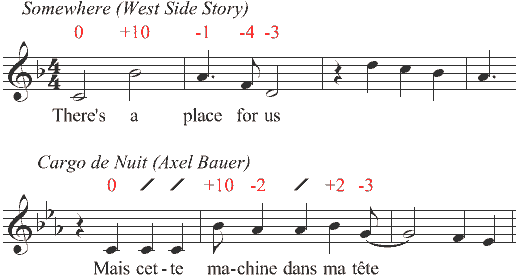
While hunting for examples of intervals to help students learn to recognize them, I was struck by the subjective difference between these two instances of the +10 move (rising minor seventh):

somewhere12

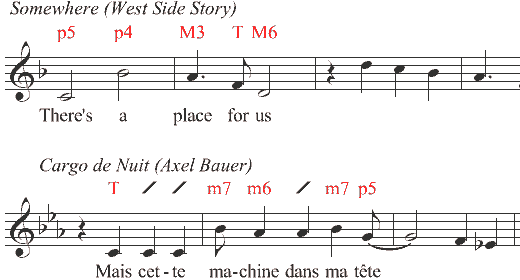
I have transposed them both so that the interval starts on C. The innocent hopeful yearning of the +10 in the first song is as distant as you can get from the pent-up sexual frustration of the same move in the second. (If you don’t know Axel Bauer’s song Cargo de Nuit you can find the excellent video on youTube.) In one of my previous posts (What’s in that Sandwich?) I remarked on the subjective difference between two +8 moves, where one was a minor sixth, and the other an augmented fifth. But here both intervals have the same classical ID of minor seventh. They do however sit in different relations to their respective tonics, as you can see here:

somewhere2

Another line of enquiry would be to ask what’s in the sandwich, that is, how are the intervals filled? Going back to the Honeycomb again, we can see that these inside notes point us in two different directions starting from C, to two different B-flats.

comma

The first lies two steps due south of C, at 6 o’clock, passing through the tonic F. This choice is confirmed by the grouping of the inside notes F, A and D in its proximity. Its frequency is 16/9ths × fC. The other B-flat (“Bb+“) can be found by seeing where the inside notes A-flat, E-flat and G are grouped above and to the left of C. Looking towards 11 o’clock in the fraction circle above we see that Bb+ has a slightly higher frequency relation of 9/20ths × fC  – or 9/5ths if we correct for octaves. The two B-flats are separated by a syntonic comma (81/80). Interestingly, if we look back at the śruti mapping, we see that the lower B-flat is in the white, or “happy” zone, while Bb+ is in the yellow, or “excited” zone.

Indian musical theory seeks to define the emotional charge of microtonally adjusted musical intervals relative to a fixed tonic. But if we adapt our analytical tools, it can also throw unexpected light on subjective emotional differences even in harmonized music based on Equal Temperament. This in turn could possibly even help composers and singers of those songs to nail the emotions they contain.

Still curious? Find out more in my Atlas of Tonespace.

Follow me on Twitter @jazzpanflute

Posted in Music Theory, Musicianship | Tagged , , , , , , , , , , | 1 Comment

Keeping Tabs

I used to play a fair bit of Japanese sankyoku music on my maplewood shakuhachi (couldn’t afford the bamboo variety!) with koto players Hideko Dobashi, Rie Yanagisawa (who also played shamisen) and later in Toulouse with Takaya Odano. Unlike Western music, each traditional Japanese instrument has its own system of tablature, and may even have more than one depending on which of many contending schools you belong to. The two main systems for shakuhachi are called Kinko and Tozan, and use kana syllables with dots on either side to indicate strong and weak beats. For the koto, the strings are identified by numbers and boxes are used to indicate measures. Since kotos can be tuned to different scales by moving the little bridges, each koto score stipulates the tuning at the top, so the string number can represent quite different pitches. Sort of like a key signature. The “accidentals” are in fact instructions to push the string down with the left hand for the sharps (oshi) and push harder (tsuyo-oshi) for the double sharps.

Here is a page of Biwa tablature dating from around 738 AD, showing what must be some of the oldest extant composer’s undos.

411px-Tempyo_Biwa_Fu

Western musical notation on the other hand takes its cue from the keys of the traditional keyboard. The white keys are left unmarked and the black notes are marked with accidentals. Originally derived from plainsong notation, it became a keyboard tablature to which all the other instruments have had to adapt in various ways, and in various transpositions to map each instrument’s “home” scale to C major. Pencil composers may have cursed these inconveniences, but they would have had to curse a lot more if each instrument required its own tablature. Imagine trombones notated with one of seven slide positions and a harmonic for each note! Or the violins written with numbers on four lines… (For some reason nobody thought to make viola scores transposing, making life extra hard for violinists called on to double.)

Nowadays guitarists are practically the only ones keeping tabs, in a tradition that goes back to the Elizabethan lutenists and beyond. Hardly surprising considering the mental acrobatics required to read keyboard notation on a guitar!

I discovered the Jankó whole tone keyboard when researching prior art as a first step before patenting my own whole tone keyboard design – which you can play by clicking on the image below:

beanboard

Needless to say, when I found that my idea was already old hat I saved myself the bother and expense of the patent! A small Japanese company has since brought the idea to fruition with the Chromatone and I wish them luck with it:

chromatone

Now ask yourself, what kind of tablature would you use for an instrument with 312 buttons and no black notes to tell you where you were? Or for a whole-tone tuned panflute which you can’t even look at while playing it? The thing about these instruments is that you may not know which note you are playing, but if the one you are playing sounds right and you gauge the interval correctly, your next note will sound right too! It’s perfect for improvisers. Everything is relative – like singing in the shower. Einstein would love this! And this was the inspiration for MOVES notation. MOVES notation is about hearing one note and getting the interval right to find the next.

MOVES is for working on melodic fragments. It describes only the intervallic matrix of the melody, and is a pared-down sequence of instructions. In the classroom it can be translated into finger gestures, and it lends itself to work with flash cards. And what is amazing is that if you transfer it to really tonality-bound instruments like the saxophone or the trumpet, it can totally transform your playing.

I look for solutions for the classically chained musician, or in fact anyone who wants to improvise, who would like to do what comes naturally – but nothing does. Some players really need precise instructions in order to feel that what they have played is valid or OK. MOVES notation helps them make the transition from playing what is “correct” to playing what is intentional. It puts your Inner Melody in charge.

Follow me on Twitter @jazzpanflute

Posted in Intuitive Instruments, Moves notation | Tagged , , , , , | Leave a comment

Let’s Build a Wall!

building_blocks

In my young day they didn’t have jazz courses. You had to blunder about picking up tips, trying stuff out and bluffing where necessary. So when I play with the young players here in France what sticks out to my ear are the traces of jazz pedagogy in their playing. It’s as if they are playing for marks, to please an imaginary teacher sitting on their shoulder. Everything becomes an exercise.

They enjoy questions like: “When can you play a whole-tone scale/ diminished scale?” When the right chord comes round they will niftily execute the scale and look pleased if anyone noticed.

“Executing” is what bothers me.

The phrase that comes to mind is: the lights are on but there’s no-one at home.

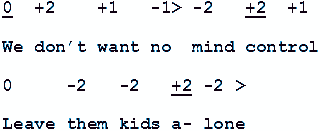
I believe in inhabiting the music we play. When we are working on playing like singing in the shower, or on what I call Voice Empowerment, we need to work brick by brick to help us “inhabit” those scales. And where better to find bricks than in the Pink Floyd song Another Brick in the Wall (I hear you groan) ?

wall

The two links are: {0 +2 +1 -1 -2 +2 +1} with linksum +3, and {0 -2 -2 +2 -2} with linksum – 4. Chaining the first link four times gives you a rising diminished scale, and you can chain the second link three times to give you a descending whole-tone scale back to where you started.

So why is this different to just playing a diminished scale or a whole tone scale that we have learnt from a book? Well let’s look at what happens in our Inner Ear at each iteration of the chain. Each time you come back to the 0 at the start, you mentally reset the fragment to the new key. So from a subjective point of view, rather than completing a diminished or a whole-tone scale, what you have done is play the short scales {2 1} and {2 2} a number of times. You are able to re-inhabit the fragment at each transposition.

Short scales have a charm of their own. They are often sufficient in themselves to make most musical statements I hear on the radio, so why analyse them as parts of a larger structure? Technically undemanding and easily assimilated by the ear, if I were starting music again they would be my first building blocks, long before taking on their 12-span brothers.

If you are keen to start playing these two bricks through all keys on your instrument, you could do worse than just splice them together like so: {0 +2 +1 -1 -2 +2 +1 =0 -2 -2 +2 -2}  (linksum -1) x 12

Follow me on Twitter @jazzpanflute
Posted in Moves notation, Musicianship | Tagged , , , , , , | 4 Comments

Musical Chromosomes

Working with whole tone panpipes has for me been a liberating experience, a shortcut to what they call stage 4 competence in NLP or what I call “mindless playing”. For those unfamiliar with Romanian panpipes, I should explain that the semitones are obtained by shading the tube with the lower lip, or by tipping the instrument towards you. So the panpipes are in fact chromatic. They are also highly intuitive. Since the instrument lies outside of your field of vision, you are forced to develop a mechanical connection between the interval or note you hear in your Inner Ear and the movement of your head and hands. The more vividly you hear that two-octave leap, the better your chances of hitting it right. Rely on theory and you are sure to trip up sooner rather than later.

Image

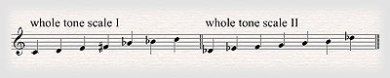
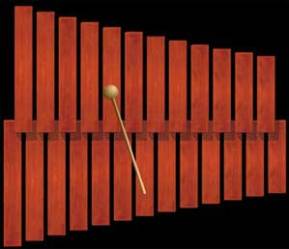
Another thing I get from playing it is a new musical creation myth. The two whole tone scales, the yang (open hole) and the yin (shaded hole) are the father and mother of all the other scales, major, minor and anything in between. As you must be aware, every major scale contains a 3-note run in one whole-tone scale and a 4-note run in the other, chromosomes from each parent if you like. If you’re not sure, try finding some major scales on this virtual whole-tone tuned xylophone (no blowing required)

Image

Whole-tone instruments also suggest different practice strategies. With conventional scale practice, you have to decide in advance which scale you are playing, and you evidently know its name. But that is not how you sing in the shower. The time you spend on playing scales is not being spent practicing improvising. So let’s try something a bit different! Start with either whole tone scale and go on up or down until you feel the urge to cross over to the other. It is a way to train your ear to make up its mind mid-flight where to put the semitones, which are what distinguish one (diatonic) scale from another. The idea is to liberate the improviser in you. Using this practice technique on the whole-tone panpipe you learn to find the right scale (the one that sounds right) without knowing which key you are in. What’s great is that it works on the violin and the saxophone too.

Scale practice is all about your muscular interface with your instrument, a way of overcoming the inherent design deficiencies of that interface. But on the musical level, a scale is an artificial construct, like music dissected and hung out on a line to dry. So next time, try warming up with just those two whole-tone scales, and play about with crossing between them at will. And have fun.

Follow me on Twitter @jazzpanflute

Posted in Intuitive Instruments, Music Theory | Tagged , , , , , | Leave a comment