Blow your horn, not your savings

The Honeycomb: useless brainfood?

honeycomb1

The Honeycomb, known by some as the Harmonic Table, maps notes on a hexagonal grid along three axes: fifths, major thirds and minor thirds. That’s nice, but what do you want to do with it?

Well, I used it to try to understand the fractions used by Alain Daniélou to describe the microtonal intervals of Indian Music in Ragas of Northern Indian Music. They are the basis of just tuning.

I then wrote a protocol, using tables in Paul Hindemith’s Craft of Musical Composition, to enable a computer to analyse in real time any group of notes and find the root and the most harmonic frequencies for the remaining notes, weighted by their proximity in the Honeycomb, and fine-tune the MIDI code accordingly.

This idea hit a wall, as no-one I knew was capable of coding a program that would interface with the MIDI inside a synthesizer.

Plus I wasn’t sure it would sound any good. A fellow explorer, Charles Lucy, sent me some recordings of lullabies made with just intonation, and to be kind, it took some getting used to. Not only that, I read a study somewhere that those Indian microtones are not observable in actual performance.

So, is the Honeycomb useless brainfood?

Yet another blowout sale!

The last thing I wanted to do with the Honeycomb was transform it into a keyboard design. So I was intrigued to learn about C-thru Music’s Axis-64 that had done just that! Belatedly, I should add. Because the company is planning to close down on January 31st 2015, and is selling off its inventory at 50% off.

So what went wrong?

Well looking at this video, possible reasons come to mind.

At the risk of sounding more like a post-mortem than a product review, here goes:

Firstly, the layout is logical, without managing to be intuitive. Or better put, the logic used is arcane. Our kinaesthetic perception of pitch starts at age dot with the muscles of our own voice, and is necessarily linear. We do not expect to have to jump across the board to find neighboring tones. Semitones want pawn moves, not knight moves.

Secondly, all those triads where three buttons meet are in close root position.  To me it is as if the designer has made naive decisions about the components of music. Specifically, it ignores the rich world of voice-leading harmony, like the basses of an accordeon.

Thirdly, the keyboard looks like it has been put together with off-the-shelf parts and cheap materials. And no designer input.

The industrial production trap

And this is the sad part, this passionate designer’s baby fell into the industrial production trap. An interesting idea takes the long and expensive route to becoming vintage attic junk.

You thought you had a winner and blew your savings on it. (I’m just guessing!) From that moment on, you hired helpers and became a company, dependent on takers to keep afloat. Not what you were born for, I’m guessing again.

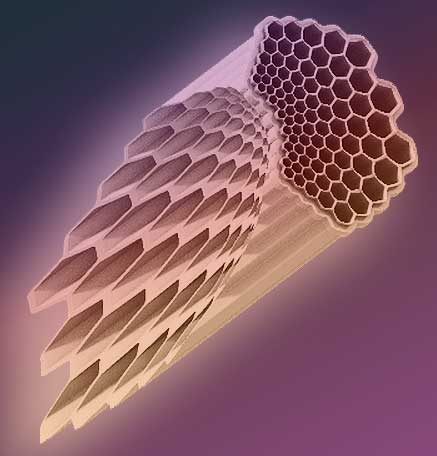
As my regular readers (both of them!) will observe, I shouldn’t be knocking the Honeycomb layout, since I used the very same layout for my feedback-mike-driven chromatic chordal passive lap organ (not sure which order to put those adjectives in), the Honeycomium.
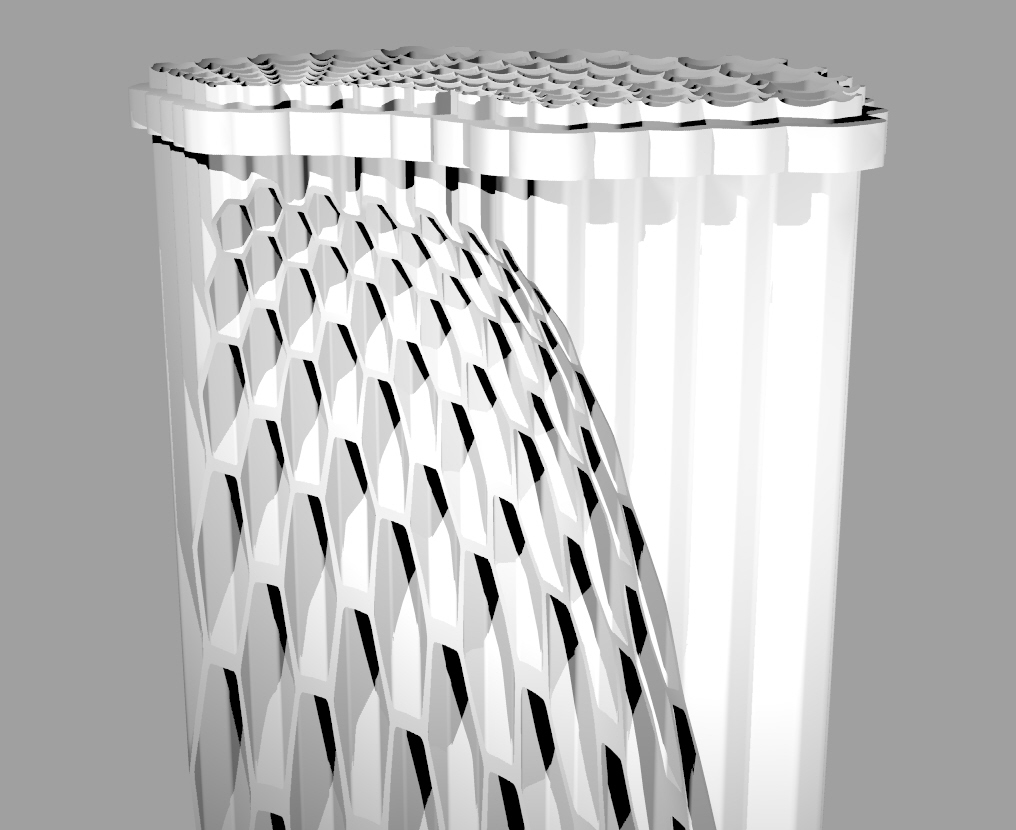
honeycomium moonshot

Honeycomium moonshot. (Artist’s impression)

True, listening to that video, when I heard his last remark “Definitely can’t do that on a piano”, referring to the random omnidirectional glissandi that you can do on it, and then looked at the price this was selling for, my thought was, so is that all I get for a grand? Five minutes of MIDI free jazz?

A toy I want but can’t afford

I made the Honeycomium as an escape from MIDI, back into the analog world, to explore endless sonic possibilities – more grunge than free jazz perhaps. And if you can’t stand it after five minutes you will be left with a mathematical sculpture, at the very least.

Your microphone plays triads wherever three walls join, but the feedback loop will revoice those triads in different ways by finding the tubes’ harmonics and adding subtones. Think Hendrix’s Star-Spangled Banner and wear ear protection.

If you are clever with electronics and duct tape you could even design a microphonic glove to play it with.

And lastly, although the 3D-printed price is not a lot cheaper than the Axis-64,  I am not a company, and I’m not dependent on you buying it. So I can be upfront with you. Don’t buy it unless you are slightly mad, have cash to spare and own everything else you need already!

And my message to fellow pioneers like Peter Davies, brave designer of the Axis-64, is don’t give up, and blow your horn not your savings! One day in the distant future, ROI (Return On Investment) will be measured in musical output.

Not.

Posted in Intuitive Instruments, Music Theory | Tagged , , , , , , , , , | Leave a comment

Honeycomium. WTF. A truly analog experience.

What singers don’t know about howling mikes

Have you ever noticed in Karaoke bars when a singer takes the microphone and it starts howling, the ones that don’t know try to cover the mike with their hand and the feedback gets worse? Their hand forms an acoustic cavity and creates a bandpass or “notch” filter that only encourages the feedback loop. Or something like that.

I remember this phenomenon being used by the sax player in a Fairport Convention concert some 40-odd years ago, when he placed his soprano sax over the microphone that picked up the horn’s frequencies with commendably manic zeal.

The idea of making a passive organ to be played with a microphone has been at the back of my mind since then. A rubber cowl, or the player’s hand over the microphone could modulate the frequency to make it more of an artistic experience, recreating some of the nostalgic sounds of the Battle of Britain.

When I was in Spain I experimented with a flexible shoe organ that used a honeycomb layout. Major or minor triads could be obtained by hitting three neighboring tubes.

akiko

With a pair of shoes, most jazz chords could be obtained. Amuse yourself for a while here.

Aeolian housing project

Some time later, by changing the axes of the honeycomb, I came up with a layout that gives a triad, minor or major, on every apex at the join of three tubes.

I first made this as a portable bundle of closed pipes hoping to be able to play it as a panpipe, but my chin got in the way. Blowing through flexible tube just made me dizzy. It ended up in the garden as an Aeolian harp, and was quickly inhabited by small creatures.

Introducing the Honeycomium

So I now bring you the latest evolution of all this research, the 4-octave Honeycomium chromatic chordal passive lap organ, to be played with one or more microphones.

It lies on your lap. As it is only 65 cm long, you can work both ends of the tubes. If your amplifier is set up right, the feedback will stop when you move the mike away from the instrument, but as an added precaution, a volume/gain pedal would not be a bad idea.

See the Honeycomium on Shapeways

The Honeycomium chromatic chordal lap organ

Shapeways have a bounding box limit so the longest tube comes in under 65 cm, offering a flute and piccolo range. However, adroit use of neighboring tubes and/or two mikes should give you amazing roaring difference tones reaching into the sub bass.

This is my first 3-D printed pilot model which you can acquire on Shapeways if you are loaded with moolah. Sometime soon I will be looking into the possibilities of printing bent tubes to get more sounding length in a smaller space.

And maybe one with less tubes to make it more affordable. And feel free to pinch the idea, using offcuts from your local plumber.

A truly analog experience! WTF.

Follow me on Twitter @jazzpanflute

Posted in Intuitive Instruments | Tagged , , , , , , , , | Leave a comment

Getting towards a tipping point

jankoss

Paul Jankó’s original keyboard on a Steinway grand

Paul von Jankó was a man ahead of his time. His ideas fell on stony ground and he ended up spending the last 17 years of his life laboring on a Turkish tobacco farm. Perhaps to get away from his creditors.

His 1882 patent for an intervallic piano keyboard (above) has been lapsed for a while now, leaving the field open for the idea to be exploited by new arrivals.

And in the last few years the field has been broadening. Here are some more recent developments. If more people keep pushing, maybe we’ll reach a tipping point and see these instruments in schools.

Paul Vandervoort has been developing his version of the Jankó keyboards in Reno, Nevada for a number of years, and is also an accomplished performer on them. He has settled on five rows as the ideal number of keys. Find out more here

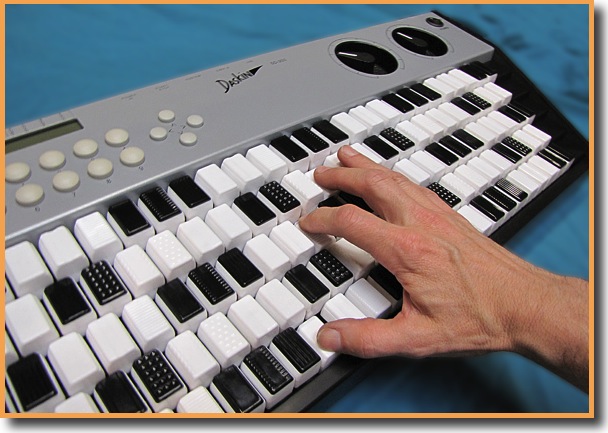
daskin_proto_v02

The Daskin wholetone keyboard

Next there is my early design, going back 15 or so years, an adaptor for a MIDI keyboard, which never got into production, and has only just found its first happy customer on Shapeways.  Sometimes you have to be patient. You can try it out here.

bbbw

Paul Hirsh’s “Beanboard” wholetone keyboard design

The Chromatone keyboard is made in Japan and packs a state-of-the-art Korg synth inside. It uses six rows, like Jankó’s version and adds an additional chromatic row for glissandi at the top. It has already been adopted by some ace players including Wataru Ohkawa (seen here playing Charlie Parker’s Donna Lee).

top05

Chromatone keyboard

And now a Belgian father and son team, André and Luc Lippens, have come up with the Lippens keyboard. The keys have a rather odd shape, that I guess you would have to try out to know if they suit you. Judge for yourself:

LippensKbd0

The Lippens keyboard

The website has some very well designed graphics exposng the illogicality of the traditional keyboard (click on the circles at the bottom of the keyboard page), and some nicely produced tutorials.

LippensKbd5

Majors scales on traditional and wholetone keyboards

While there seems to be a growing consensus about the keyboard design, the same cannot be said for notation reform. Both the Chromatone and the Lippens websites offer their own homemade notation systems, and they are only two among many.

In fact the sheer multiplicity of different notation systems and the inability of folks to get together and agree on the best one, makes me want to stay out of the discussion. I see from the list that I am no longer a member of the Music Notation Modernization Association.

Back in the day I had my own winning idea for the best way to notate for 6×6 keyboards and wholetone panpipes. Unfortunately my system has been lost to a grieving posterity, as I lost the paper I wrote it on and can’t for the life of me remember what it was.

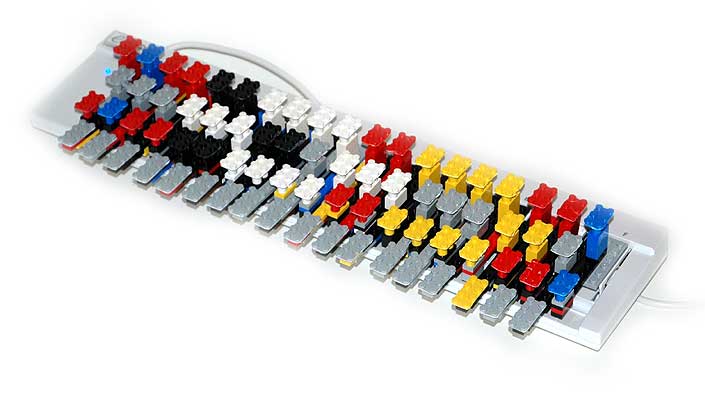
If you hear of any wholetone keyboards I have left out, let me know in the comments section. And being hard up for cash is no reason to let the wholetone revolution pass you by. I leave you with keyboard pioneer Alex Mauer‘s elegant Lego conversion to inspire you:

alexmauer

Alex Mauer’s Lego keyboard

Did you know?

Synth keyboards and Lego are both made of ABS (acetyl butyl styrene) plastic, which is soluble in Acetone. No special glue is needed. Just paint acetone onto both surfaces and press parts together for 2- 5 minutes.

Follow me on Twitter @jazzpanflute

.

Posted in Intuitive Instruments | Tagged , , , , , , , , , , | 4 Comments

How to convert your panpipe to wholetone tuning

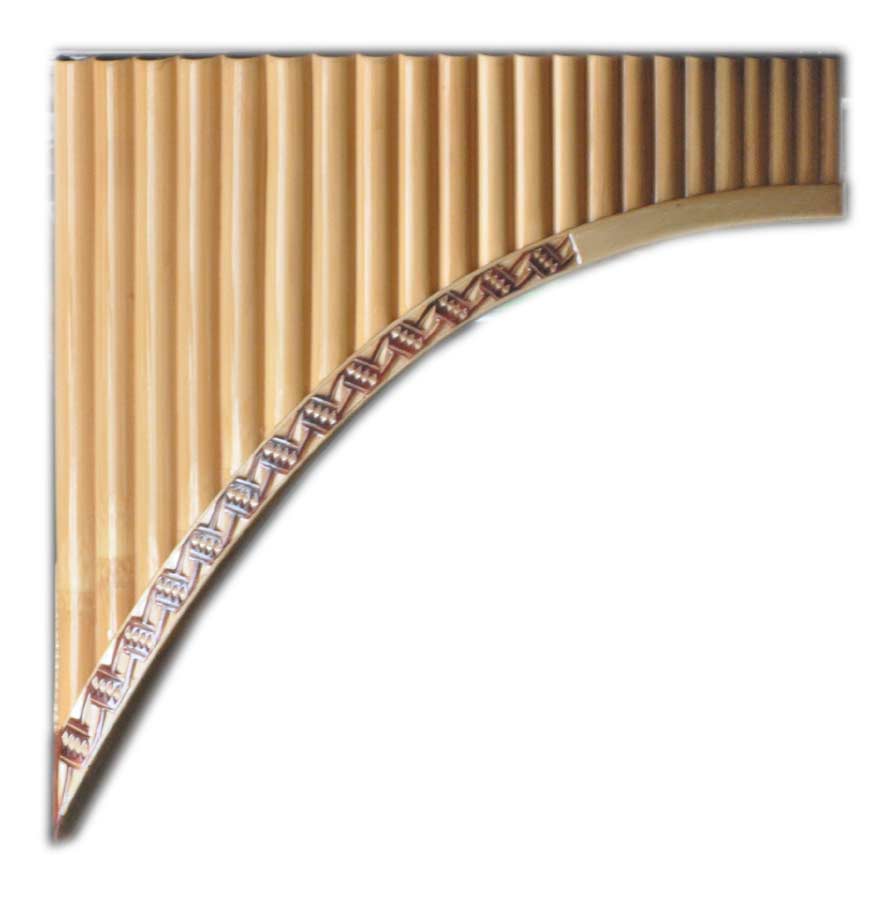
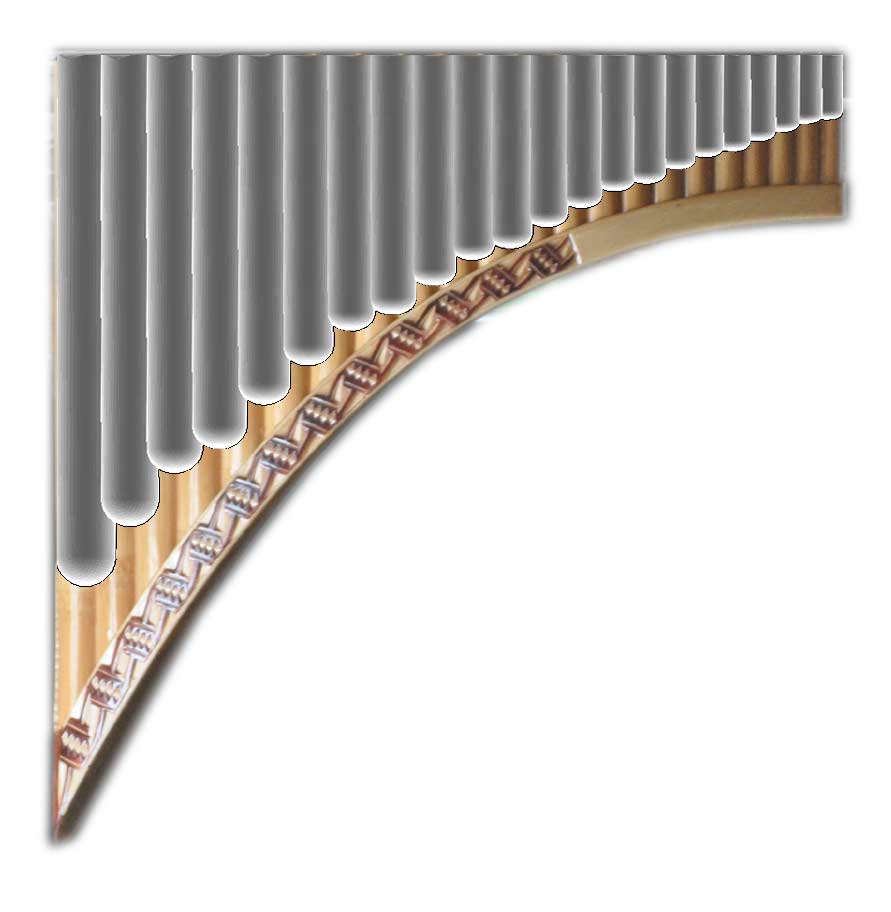
So your Gran bought you this beautiful Romanian nai for Christmas and the first thing you want to do is convert it to wholetone tuning so you can play all your favorite Charlie Parker tunes on it – in all keys.

retune_your_nai1

She would of course be horrified if she knew what you were about to do, so choose a day when she is not about, preferably a warm day when you can send her to the seaside. You are about to see why.

The tubes are joined at the bottom by a beautifully curved (and sometimes carved) piece of wood. This disguises the fact that the inner lengths of the tubes do not describe a beautiful curve because some of the intervals between tubes are tones and some are semitones. Below you can see what the inner lengths would look like if you could see through the instrument. I am not sure that the extra length at the bottom makes the thing easier to handle.

retune_your_nai2What we are about to do is replace the diatonic scale G A B C D E F# with the whole tone scale G A B C# Eb F G. We will need an electronic tuner, some beeswax and wooden tuning rods. They have one flat end for tamping down the wax and another shaped like a four-cornered chisel to remove the surplus wax. You can find pictures of these and very detailed instructions on how to use them on Dajoeri.com. If you can’t buy them they are easy to make with some dowelling.

Beeswax is preferable to candle wax, because it sticks better and stays softer, in case you put in too much and need to scrape some out with the sharp end of the rod. It also doesn’t shrink so much when it cools. Also never pour in liquid wax,  as it sticks to the sides and ruins the sound. The wax should be sticky-soft, which was why I recommended choosing a warm day. Otherwise find some way to warm it without it melting, like rolling it in your hand.

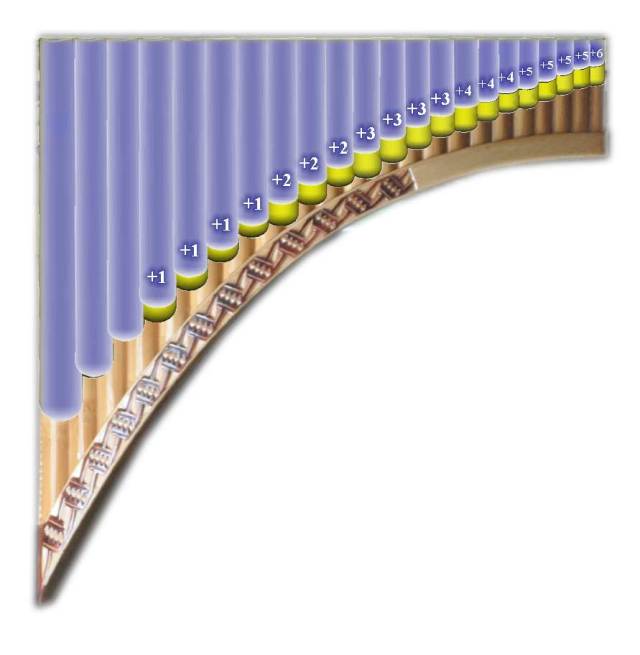
So here is what we will have to do. Starting from the bottom, the first three tubes keep the same tuning, G A B. The next four tubes (C D E F#) need to be raised a semitone (+1) to sound C# Eb F G. To do this we will need to shorten the inner length by about 5.7% by adding in wax. The next three tubes will need to be raised a whole tone (+2). This means the length will be roughly 11% shorter. This is to give an idea how much wax to put in. And so we carry on up the tubes as in the picture below. The orange represents the beeswax you will have to add, and the numbers represent the semitone change:

retune_your_nai6

Now you will notice the very highest tube is raised by three whole tones (a tritone) and makes a sound that only a dog can hear. In fact your 19th tube now makes the sound that your 22nd tube used to make, and even that is something you normally avoid playing. I don’t recommend sawing off the top three tubes or your Gran will freak out. Just don’t play them if you want to avoid damaging your hearing (or your Gran’s).

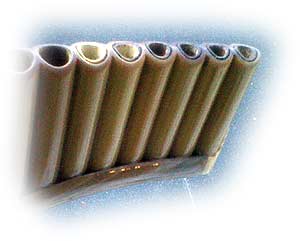
So far you have only changed the lengths of  your tubes, but this creates a problem at the extreme top end, because you didn’t reduce the diameters. Your top octave is probably hard to play, with the notes sounding a bit wild and unstable.

I have made bamboo fillets for this instrument using gardening bamboo

retune_your_nai5

The trick is to use a small round file to hollow out the bamboo from the inside first, before shaving the outside down with a sharp knife to fit inside the tube. If you do the outside first you risk breaking the bamboo when you file the inside. We are talking less than a 2mm reduction, which means the walls of the fillet will be just 1mm thick! Once the fillet fits snugly inside the tube, cut the fillet to length and smear soft wax (not glue!!) on the outside before placing it in the tube. Dont force it! If it is too big it could split the tube, so be gentle and work patiently. Sand off the top of the fillet and you are ready to go!

This operation should be reversible if you decide you don’t like wholetone tuning. But give it a month, and I am sure you will be converted to the wholetone system!

You can learn more on tuutflutes.com. And I wish you Happy tuuting!

Follow me on Twitter @jazzpanflute

Posted in Intuitive Instruments | Tagged , , , , , , , | 2 Comments

Scales can lead you astray

OK so you want to play faster than you can think. Scales are the way to go! You can vary them a bit by playing them in thirds (up two down one) and keep going (up three down two…). Then do the same stuff with all the other scales – the harmonic and jazz minors, which is what you get when you play the ascending melodic minor the same way downwards. Some blues scales? OK. How about something more exotic? Go for it!

After years of daily workouts like these, you can blow people away without having to take your left hand out of your pocket.

But what about playing along with the chord changes? I hear you shout.

If you listen to some teachers, they tell you to use this scale, use that scale.

But wait a minute! I’m trying to get you to play what’s in your head. Like singing in the shower. At no stage in that process do you “use” a scale. Perish the thought!

Besides, everything you have been told makes no sense.

Play C major over C major, and D dorian over Dm7.

What’s the difference?

D dorian uses the same notes but goes from D to D 

So that means I play a phrase in C that starts on D?

No, no, no, you try to keep it varied. Just use your… inspiration. 

Now I can really hear you scream!

So today I want to show you a different way of thinking about those pesky things. I want to talk about a thing I call chord focus.

Pick out any song from any song book and look for altered notes, sharps, flat and naturals in the melody. Discard passing notes (ones that move by a halfstep to land on a regular note). Now check out the chord that underpins those notes. You will see that 9 times out of 10 the altered note is the third of the chord. With some reservations…

Going into more detail here: a non-passing accidental sharp (or natural when the key sig is full of flats) in the melody can nearly always be harmonized as the third of a dominant seventh.  Take the first line of All of Me:

allofme

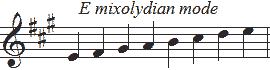
Imagine you only had the melody to go by, without those chord symbols on top. That G-sharp in bar 3 is telling you I’m a third of a dominant seventh chord, so you play E7.  But if you think that means you should be playing in E mixolydian over it, think again!

mixo

That F-sharp and C-sharp will sound oh-so wrong!

OK a couple more years of theory will tell you why that’s wrong.  Something to do with preparing the A minor chord that follows on the next line. But there is a much simpler way to understand it. And it is what intuitive improvisers are doing without even thinking about it.

The French name for accidentals is “alterations”. And in fact that is all that has happened here. One note has been altered!

So should we just stay on the C scale with a G-sharp instead of a G? Or an E phrygian mode with a raised third? Don’t even think of it that way! Forget scales and modes.

All the intuitive player needs to know is the focus of the chord – in this case the G-sharp. It’s the note that invites him and leads him into the chord, the note he wants to orbit around.  Instinctively he will avoid doing that in a way that shifts the focus on to a different note. He also won’t want to change its function. He won’t want to make that G-sharp be mistaken for an A-flat (by playing it in an F minor arpeggio for instance – save that for bar 26). Think surrounding notes.

Its like a coloring book. The chords are there and you color them in. You color in the horse. You don’t change the horse into a bear, or daub it beyond recognition. My mentor, Chris McGregor, showed me that the soloist should enhance the chord that the band is playing, or at least try not to detract from it.

Follow me on Twitter @jazzpanflute

Posted in Music Theory, Scale Practice | Tagged , , , , , , , , | Leave a comment

Learning one halfstep at a time

If you want to know what quartertones sound like, get your class of kids to sing the Beatles song When I’m 64. The second line is supposed to sound like this:

whenim64

And what you will generally get, when you average out all the voices, is something  like this:

whenim65

So what went wrong with the birthday greetings? They didn’t have that trouble singing the same notes at twice the speed in bar 1, with “Will you still be sending me a-“.

It could be that the E-flat on the second syllable of “bottle” is somehow dragging up the D of the second syllable of “greetings”. Or the B-flat in Valentine has sucked down the entry on “Birth”. After which the rider never quite gets back in the saddle, so to speak. Sort of magnetic effect.

Either way, chromatic passages are a minefield for the learner. To learn to hear and sing them correctly requires careful and disciplined work.

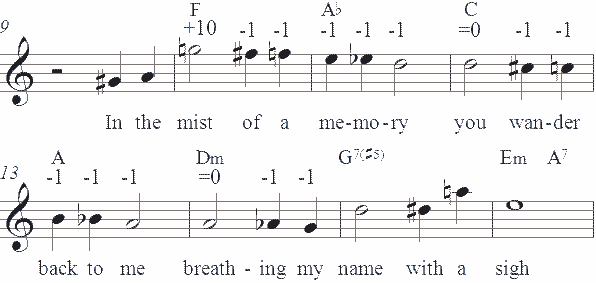
It is hard to find examples of a rising chromatic passage in the popular songbook any longer than 3 successive halfsteps. The only one that comes to mind is in the last bar of the bridge of Duke Ellington’s Prelude to a Kiss. Was he trying to prove a point? 3 rising halfsteps seems to be a limit for the untrained singer. So you might just have to chain up this 4 times to fill up an octave:

{=0  +1  +1   +1  -3  +1  +1  +1} × 4
will  you  still  be  sen-ding me a

Or if you prefer, you can use the opening phrase of Chattanooga choo-choo, where it goes:

=0  +1  +1   +1  >  =0  +1  +1   +1 >  =0  +1  +1   +1 >  =0  +1  +1   +1 >
Par-don me boy –   Par-don me boy –  Par-don me boy –   Par-don me boy

At each iteration of the phrase we can hear that we are transposing up by a minor third, so in fact we have merely practised the short scale {1 1 1} and stacked it four times.

Thelonious Monk chains up that very same link in bars 5 and 6 of his tune Blue Monk:

To convert it into an octave-long chromatic scale we need to keep singing it until we can store it in our auditory memory and perform it without the pauses and the =0 moves.

When it comes to descending chromatic scales we are in luck.  I don’t know if he did it for a bet or if it just came to him in a dream, but we should take a moment to remove our hats for Peter de Rose, whose 1933 hit Deep Purple has a complete octave of descending semitones (-1):

deeppurple

As you can see he takes a breather after every 5 halfsteps, so we are dealing with the {1 1 1 1 1} short scale. This is confirmed by the accompanying chords, C, F and Dm-G7. You can work out how to stitch that into a single scale by singing it to your auditory memory and retrieving it without the =0 moves. This is a key skill in developing your intervallic awareness. Some people do it without thinking, but if that’s something you’ve never done, try it now. You can find the passage 50 seconds into this video (note how Paul Whiteman’s over-the-top introduction slings in a few descending chromatic scales in triplets on the piano before the tune even starts – just to get you prepped up):

Five descending semitones is also as far as Duke Ellington dared to go in his ballad Prelude to a Kiss. Whether that’s based on some hidden rule of music or just a meme, or whether there’s any difference between the two, I leave you to ponder.

Be that as it may, for a complete ascending and descending chromatic scale (again in triplets) feast yourself with Herbie Hancock’s tune Toys which starts after a minute-long microtonal bass intro from Buster Williams:

Follow me on Twitter @jazzpanflute

Posted in Interval Training | Tagged , , , , | Leave a comment

How tots discover they don’t like “music”

Early learning materials conceived to initiate tots into the making of music suffer from conflicting design aims and manage to put quite a few little fellows off from the outset.

It is often wrongly assumed that kids who don’t pursue music are simply not interested. Whereas in fact they may feel as if they hit a brick wall, unnoticed by their carers, because of a mismatch between what they hear as music and what gets shoved in front of them by the music teacher or assistant. They take one look at the map and don’t recognize the territory.

I checked out Montessori materials, hoping to find some more enlightened approaches but was disappointed. Sure, the Montessori philosophy stresses independent discovery rather than rigid learning, but the mapping of the content is still adult-centric. The major scale still rules – despite singer Rihanna’s earnest efforts to dislodge it – and those sharps and flats are still painted black.

Here’s me sounding off. Correct me if I’m wrong.

Follow me on Twitter @jazzpanflute

Posted in Music Education | Tagged , , , , , | Leave a comment

Visualizing the Seven Dwarfs + Cinderella

modes_s

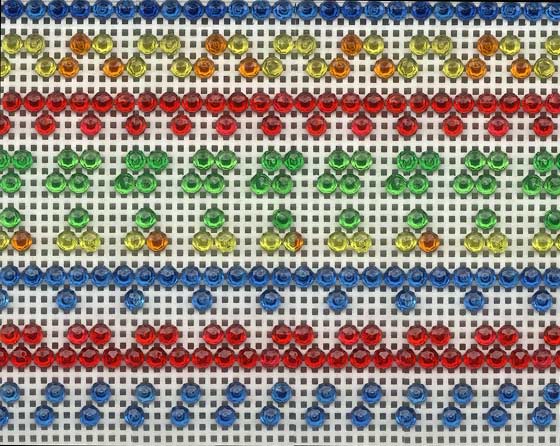
No I haven’t suddenly taken to designing embroidery patterns for Romanian shirts. I used this old toy I found in the basement to show you how the player of the double-wholetone-row xylophone or wholetone panpipe player visualizes Messiaen’s seven “modes of limited transposition” – plus the augmented scale that he left out, tripping along the bottom of the image.

Maybe she is Snow White, or maybe, since she was left out, Cinderella.

As for the dwarfs, you will recall they are named Bashful, Doc, Dopey, Happy, Sleepy, Sneezy and Grumpy. So please have a think about which name corresponds to which mode and let me know your views in a comment.

Follow me on Twitter @jazzpanflute

Posted in Intuitive Instruments, Music Theory | Tagged , , , , , , , | Leave a comment

Olivier Messiaen’s seven dwarfs

One of the fun things about playing wholetone panpipes is the way they make short scales – not just the whole tone scale – ridiculously easy. Short scales are my name for a large family of interval arrays that includes the so-called symmetric scales, including the wholetone, diminished and augmented scales. Some short scales, such as {3 2 1} are not symmetric, in that upending the interval array gives you a different scale {1 2 3}. Other short scales, such as {3 2}, do not even factor into 12, and so do not make a neat octave-long scale when stacked. French composer Olivier Messiaen collected seven short scales and called them “modes of limited transposition“, kind of a wonky way of saying that you won’t get twelve different transpositions of them without many of them containing the same notes as each other. Curiously he left out the short scale {3 1}, or augmented scale as it is known to jazz players. Maybe he wanted to keep the number down to just seven dwarfs.

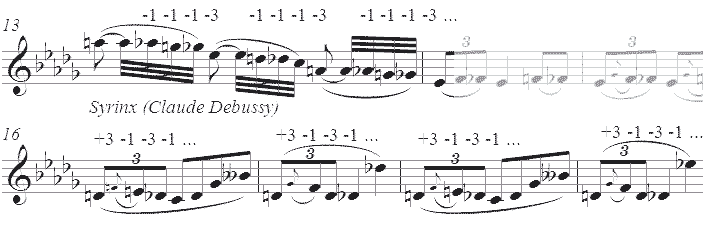
Claude Debussy is generally accepted as the pioneer of these babies, and is widely known for making the wholetone scale an accepted colour in the musical palette. But he didn’t stop there. In his composition for flute solo, posthumously titled Syrinx,  he uses a variety of scales and short scales.  In measure 13 below we see a descending {-1 -1 -1 -3} × 3 flourish. The {3 1 1 1} short scale thus mapped out is Messiaen’s fourth mode,  And then in measure 16-19 the composer plays with a descending -1 -3 -1 figure beginning on a grace note within the triplets. He bounces it up, then down, a semitone, and then up and down again. What scale is he in? Or is he just having fun?

syrinx debussy

A lot simpler than it looks

On the visual front, it’s worth taking a glance at the score with the mindset of someone who doesn’t read music all that well. With all those flats in the key signature countermanded by naturals and double flats, you would need to be a pretty good sight-reader to play it right first time. The notation camouflages a simple concept and bars access to rank beginners. It kicks something simple into the rough and makes it the preserve of the advanced student. I wouldn’t say it was deliberate mystification, but it perfectly illustrates the adage that the map is not the territory. The basic problem lies with the system of key-signature + accidentals, notating all notes as members of or deviations from a putative major scale or its Aeolian mode (here D-flat major or B-flat minor).

But now the wholetone panpipe and wholetone xylophone can put that right. With them, you can invite these friendly little dwarfs into your cabin, and let them loose on your imagination. And give them to your three-year-old to play with.

Follow me on Twitter @jazzpanflute

Posted in Interval Training, Music Theory | Tagged , , , , , , , , | Leave a comment

Why kids give up

“I did a bit of piano when I was little”

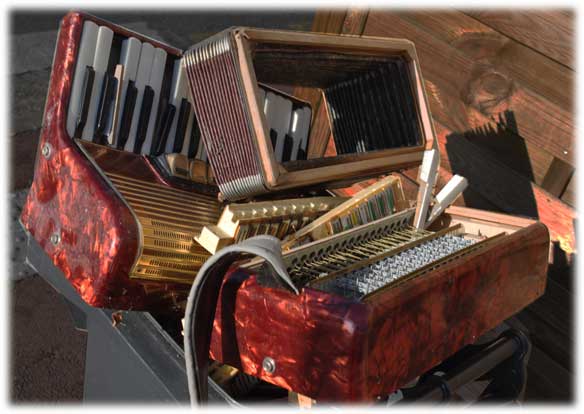
accordeon

How many times have you heard that? Do you even need to ask what went wrong?

The piano keyboard, whose design dates back to before the discovery of equal temperament, simplifies the execution of one scale (C major) and in so doing complicates the other eleven. What is more, because of its physical configuration, the correct division of function between the thumbs and the remaining fingers necessitates a high level of training to master.

A similar minefield awaits learners of other popular educational musical instruments. School xylophones replicate the difficulties of the piano, or else remove the problem by leaving out the black notes altogether. As for the recorder, the learning curve is so rugged after the first few nursery rhymes that it must have the poorest follow-through rate of any instrument ever invented. And this is not surprising. Since the pitch changes with airflow speed, upwards of 300 fingerings need to be mastered to keep it in tune at all dynamic levels. Its only justification is surely price.

And why do we start kids on C major anyway? As I mentioned in a previous post, my saxophone beginners all wanted to start on tunes in “exotic” scales: Simpsons Theme, The Pink Panther, Mission Impossible, James Bond. And when it came to learning scales, the Blues scale was the outright winner.

The classical musical instruments of Europe have rarely been designed with learning curves in mind, if at all, and students without the patience to go through the process of learning to read music on a technically demanding instrument often fall by the wayside until they discover some less demanding “ethnic” instrument like the kena, the kora, the balafon or the gamelan. Or the guitar.

the guitar as teacher

The enormous success of the guitar in the last century reveals one of the main design criteria for a successful improviser’s instrument. Because people conceive and recognise a melody by its intervals, the improviser’s ideal would be an instrument on which an interval looks the same regardless of its transposition. (For still more efficient single line improvising try retuning the guitar to “oriental” tuning in fourths, viz:  E A D G C F.) You could say the guitar’s most important role has been as a surrogate musical university for musicians who hate reading or Beethoven or both. The problem is that guitarists tend to hit a wall when they discover its limitations compared to keyboard instruments.

When the problem is properly described the solution stares you in the face. Kids want to play music. But they don’t have a particular fondness for major scales (at least the boys don’t). And they certainly don’t want to have to learn 12 different routines for playing them, for no perceptible added pleasure, or be told they used the wrong finger for no discernible reason. Kids know when they have been led up the garden path and often give up music as a way of punishing their elders for not having warned them of the difficulties to come.

so what would I suggest?

xylofoto

Just have one of these double-wholetone-row xylophones somewhere in the house or classroom and your children will have something to beat on from a very early age. Once in a while you can show them where to find a note when they’re struggling, but avoid the temptation to give structured lessons. Even grown-ups cannot pay attention for more than 20 minutes, according to Oren Klaff. Let them discover intervals at their own pace, at the same time as assimilating the whole tone layout. Every type of scale has only two “shapes” to discover (rather than “learn”). Transposing between keys loses all its mystery and is something they won’t even need to think about.

So much for the process of conceptually mapping the notes. Sound production on a wind or bowed instrument is a different kettle of fish, and belongs to a different stage of learning. If a child wants to learn the whole tone panpipes, I would let them begin with a single bamboo tube closed at one end, which they can carry around in a pocket, and toot whenever the fancy takes them. At some stage they could be challenged to lip down a semitone.

A different problem comes with the violin, where it is often the tolerance of the siblings or parents that gets put to the test. Why not start with a four-string mandolin? Even beat up old mandolins can take the tension of four, rather than eight, strings. The tuning is the same and that way a child can see at a glance where notes are without the added discouragement of learning to bow and hold the thing properly (keep that arm up!!!).  Too many problems to solve at once are a recipe for confusion.

Follow me on Twitter @jazzpanflute

Posted in Intuitive Instruments, Music Education | Tagged , , , , , , , , , , | Leave a comment