Reading Between the Dots

One of the commonest exercises in  jazz improvisation methods is the transposition exercise. You are given a lick or an arpeggio, usually in the key of C, and you are required to practice it in all twelve keys. The assumption is that this will help you aquire fluidity in all twelve keys. The problem is it doesn’t “work” for everyone. So let’s look at four students confronted by this exercise and see what’s happening…

Andrew takes one look at the exercise, “gets the idea” and turns the page in search of another exercise where the transpositions have been written out.

Barbara can sight-transpose chromatically, that is, she can mentally add or subtract a fixed chromatic interval (number of semitones) to or from the written note and play the exercise as if it wasn’t there.

Charles is a bit slower. He transposes by degree. Each note is identified as a certain degree of the written key. He then plays that degree of the target key. He is apt to falter when he sees an accidental.

Deirdre has invented her own method. From the written page she extrapolates the interval of each note change (up a minor third, down a fourth) and transposes by merely changing the starting note.

Ask any successful improviser (or better still, ask yourself!) which of those four students has “improvising talent”, and the answer should be obvious. Note that I haven’t said a word about ear training or playing by ear. Many classical musicians can hear frequency differences to within one Hertz and still can’t improvise. The only difference between A, B, C, and D was their approach to the exercise. What Deirdre nailed instinctively was to isolate the intervals that make up the melody.

Another student with a problem is Ernest. Ernest’s pet phrase is “Ah yes, but is it music?” Or “Is it valid?” He has lived so long worshipping musical geniuses, usually classical composers,  that he automatically assumes he is not authorised to play anything not written by them, let alone something not even written at all!

Most people have heard of Neuro Linguistic Programming (NLP) which in the last forty years has become something of a proprietary cash cow for its initiates, and gets easily confused with Scientology as a result. Among other things, it goes about finding the shortest pathway to instilling (or installing) a skill or change of behaviour. One of the hardest things the jazz teacher has to confront is the student who has too much reading or muscular skill on his instrument and tries to adapt those already mastered skills to cracking the improv thing, instead of going back to square one to build a new skill. I call these the “classically chained”. Because we always prefer what “works for us”, one of the greatest obstacles to acquiring a new talent is having an analogous, hard won talent already!

MOVES exercises are written in intervallic notation in order to leave the player no choice but to replicate Deirdre’s approach, regardless of what level they may have attained with other musical skills. My Shortcut to Improvising Fluency is a workbook for all musicians, that makes sure you work on your melodic autonomy, or the ability to play what comes into your head with the ease of singing in the shower. Note that a “shortcut” is not a time warp or wormhole that gets you there in no time without effort. It is just the shortest path between point A (where you are) and point B (where you want to be). So if your ladder is leaning against the wrong wall, don’t keep climbing. Get the Shortcut!

Follow me on Twitter @jazzpanflute

Posted in Musicianship | Tagged , , , , , , , | Leave a comment

Six Seconds Make a Seventh

Six seconds make a seventh? Is time expanding? How do they do that? Simple! The same way as two thirds make a fifth! Two fifths make a ninth, but three of them make a thirteenth, which is also twelve seconds. Try this on your music teacher and watch him get his head around it.

Classical musical theory can’t multiply and refuses to add up. The terminology sucks too: “a fifth” is an interval, but “the fifth” is a note.

It doesn’t help that there are 31 notenames for twelve notes. You may want to hear how horrible that would sound if all 31 were allowed equal rights:

Image

In fact the only argument I ever hear in defense of this cock-eyed theoretical tradition is that it has been around longer than you and that’s what we are used to. Well I have to admit, I’m used to it too. But we should always bear in mind the adage that “the map is not the territory“, and here we have an extreme example. So when I wanted to write down the kind of mental operations an improviser performs instantly without thinking, there was no way I could carry on with that stuff. Melodies are interval structures, independently of the key they happen to be in. Tonalities are a distraction from the business of playing what you hear. MOVES aims to notate intervallic movements to help you develop your melodic reflexes. So the simple answer to the question “why use MOVES notation?” is: “Because it adds up.” And it honestly doesn’t take seven years of music school to get used to either.

Follow me on Twitter @jazzpanflute

Posted in Mappings, Music Theory | Tagged , , , , , , , | 4 Comments

What about harmony?

That’s right. What indeed? MOVES notation is a single-line notation. It notates melodic ideas. Its aim is simple and single-minded. To get you playing like singing in the shower. You can go on to more complicated stuff after you master this.

Most improvisation methods draw on so many sources – chord theory, scales, modes, licks and patterns – that conflicts and hesitations are almost built-in. When you are playing with chord changes, do you need to have the chord chart in front of you? Do you relate the name of the chord to your choice of note and let your ear take it from there? There are so many possible approaches, is your plan to go through the formulas one by one to create variety? Plus, the improvising process gets complicated by so many heterogeneous inputs, and further clouded by doubts such as

  • Do I sound modern enough?
  • Why do I keep playing the same thing?
  • There must be other scales I can play on this
  • Why can’t I play more outside?
  • That’s too derivative, etc etc

How can you create a thing of beauty with all that going in your head? So the purpose of MOVES notation is to train you to listen to just one inner voice, and to train that inner voice to be the sole pilot of your instrument, unencumbered by doubts and feverish calculations. Now, that doesn’t mean harmony is irrelevant. Far from it. But that harmony has to be in your Inner Ear first before you can say anything meaningful about it on your horn. And that means training your melodic muscle to respond to what you hear.

For those of you who want to get started but have no access to a piano or guitar to help you hear those chords, here is a chord selector I made years ago. Just turn the dial at left, select your chord qualtiy and hit “play chord”. Then try singing along with the chord. Above all don’t think of this as a test! As Duke Ellington famously said: “If it sounds good, it is good.” The purpose is to get your ear responding to that harmony and piloting your voice. It is about getting the rider into the saddle. Only that way will you ever play convincing music on your horn.

Image

Or failing that, do what Charlie Mingus was advised to do when he started out. Play along with the radio!

And remember to check out the MOVES page and leave your comments here!

Follow me on Twitter @jazzpanflute
Posted in Moves notation, Musicianship | Tagged , , , , , | Leave a comment

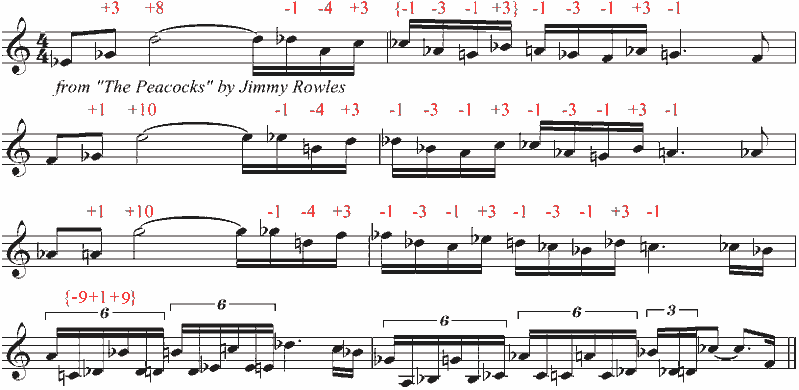
Anyone trying learn the bridge of Jimmy Rowles’ sublime composition “The Peacocks” will end up consciously or otherwise doing a MOVES breakdown of the patterns it contains. In the illustration you can see the bracketed patterns are {-1 -3 -1 +3} and {-9 +1 +9} with linksums (do the math!) of -2 and +1 respectively, which if you’ve been keeping up, means that one descends in whole tones at each iteration while the other rises in halfsteps. The first thing the player will want to do with these patterns is play them through all keys as an exercise. But that is not the only takeaway offered by this tune. With MOVES notation the range of possibilities explodes. By substituting any integer for those 3’s and 9’s we can derive a host of other patterns, some that descend in whole tones, and others that rise in halfsteps. In addition, if we need patterns that rise in whole steps or descend in halfsteps, then we simply reverse the + and – signs. Just staying within one octave, that gives us 48 different patterns, which when you multiply by 12 houses is going to keep you busy for at least a day or two!

Image

In the old days, the customary method for studying such chromatic patterns involved buying Nicolas Slonimsky’s Thesaurus of Scales and Melodic Patterns and slogging through pages and pages of infra- ultra- polations and ditone progressions. I don’t know what happened to my copy but  I remember the weight used to topple my music stand, sometimes ending on my foot. My feeling is that while Slonimsky is great for one’s sight-reading, it does nothing to free up your improvising soul, and the dividend in intervallic awareness sometimes gets lost in the visual process of reading.

Follow me on Twitter @jazzpanflute
Posted on by jazzpanflute | 5 Comments

What Boys Like

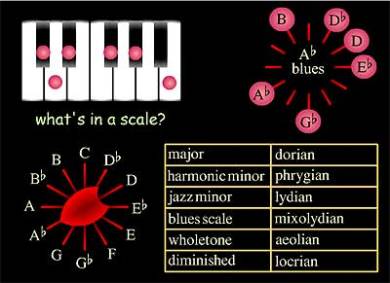
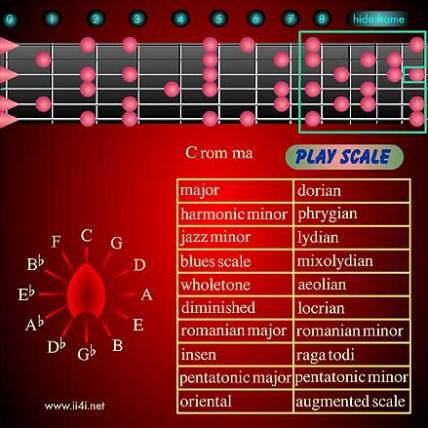
When I taught beginner’s sax to ten-year-olds I used to ask them what was the first tune they wanted to start work on right away. There was a clear sex divide in their preferences. “Doh, a deer” and “East Enders Theme” were favourites with the girls. Top choices for the boys were: The Simpsons, The Pink Panther, and Mission Impossible, closely followed by James Bond. These tunes all share one thing in common: no amount of diatonic scale practice is going to help you nail them! So I ask myself, why don’t we give these “exotic” scales (that half the world seems to prefer!), the same treatment as regular scales, and practice them every day in all 12 keys? Part of the answer may be, well, where do we stop? But I also think the problem comes down to musical instrument design. Just take a look at the arbitrary shapes made by the blues scale on the traditional piano keyboard as you turn the dial on my “What’s in a scale?” page:

Image

As you can see, it’s just too much to take in! Which is why I advocate whole-tone based instruments on which any scale will only have two shapes to cover all 12 houses.

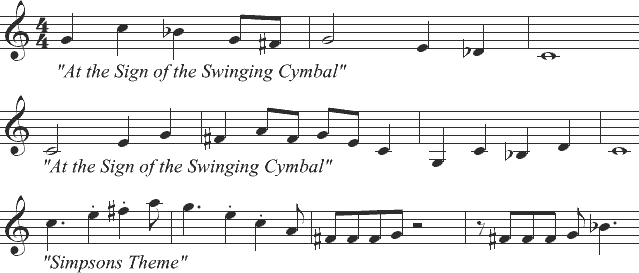
Let’s look at the boys’ all-time favourite TV theme, the Simpsons, which scale-wise changes every four measures with a sprinkling of wholetone, blues and other scales. The tune itself kicks off in a scale which turns up in a lot of Romanian “Lautareasca” music: 4 2 1 2 1 2. Old timers may be reminded of the Pick of the Pops theme, aka At the Sign of the Swinging Cymbal, which announces a similar scale with a choice of major or minor seconds:

Image

I doubt even Romanian accordeonists work this scale in all 12 houses, and this is where guitarists have the edge. As you know, when a guitarist wants to transpose up a halfstep he simply moves his axe to the left. To help them, I made a special version of “What’s in a Scale” with a moveable frame for each left hand position. Now they have no excuses left!!

Image

Follow me on Twitter @jazzpanflute
Posted in Music Education, Scale Practice | Tagged , , , , , , , , | 3 Comments

Seventh Heaven

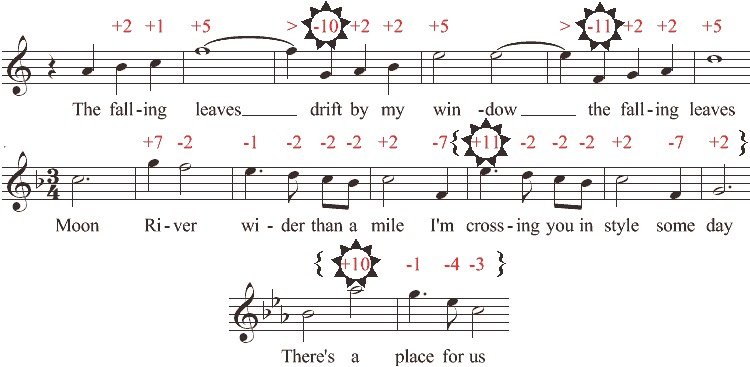
Like Monsieur Jourdain in Molière’s Le Bourgeois Gentilhomme who didn’t realise he had been talking prose all his life, most of you have performed faultless major and minor seventh leaps (± 10 or 11) without thinking. Yet if asked to sing a such a leap, how many would get it right? Here are 3 very well known songs that contain them.

sevenths1

You can practice these by looping the MOVES inside the curly brackets on your horn, always remembering to sing the note in your head before going for it. Both links have a +2 linksum, so you go up a whole tone at each loop. This means you will only practice the leap in six different houses, unless you figure out a way to slip up or down a halfstep and do it six more times.

You may want to check out the MOVES page for explanations of words in bold type.  For your listening pleasure, and to help you revise that major seventh, here is Audrey Hepburn with Moon River.

Posted in Interval Training, Moves notation | Tagged , , , , , , | Leave a comment

Slow down

Teachers never tire of telling students to play it slowly, and students often cannot see the point. One thing I can suggest is that you use the time to conjure up a yearning for the next note, so that when it finally arrives it is like the fulfilment of a fully formed mental image of the note, with pitch, dynamic and sound quality fully pre-formed, as it were. However, one thing I’m not too fond of is the use of metronomes to help you keep slow, as having to keep in time with that clacking sound imposes its own burden on the ear. And this is where YouTube comes to your aid. Now that you can find practically any piece of music on YouTube, all you need to do is click on that cogwheel (or daisy?) at the bottom and up comes the speed menu. A lot of people don’t know this, but you can slow the videos down to half or even quarter speed without the music descending through the floor! Also great for learning or transcribing guitar shreds.

Image

Posted in Musicianship | Tagged , , | Leave a comment

A (Random) Scale a Day

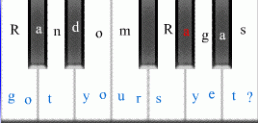
There are some 2048 possible interval arrays spanning one octave starting from a given note. Some of these are labeled arpeggios and others make up scales. The most numerous are the hexatonic and heptatonic scales with 462 types each. Next come pentatonic and octotonic with 330 varieties of each. For arrays with 4 or 9 notes the possibilities come down to 165 each. To complete the list there are 55 arrays with 3 or 10 notes, just 11 possible arrays with 11 or 2 notes and 1 each for that single lonely tonic, or the whole chromatic scale. Here I have tweaked the odds to give you something useful to play, when you click on the image below:

Image

Posted in Scale Practice | Tagged , , , , | 2 Comments

A Kind of Hush

A Kind of Hush

A Kind of Hush

{-1 -9* +5 +4 -2 -3 -3 +6 -2 -8* +5 +3 -2 -3 -3 +6} x 12

This is an exercise that is easy to hear in you head, as it comes from the hook of a pop song. It goes through all major, minor and diminished triads, so it is bound to help you on your instrument on a purely technical level. It is also an extremely powerful tool for developing your ear-playing chops, on one condition: that you play it by ear! Everything hinges on whether you write it out into all 12 keys and play it from the score or whether you hold the melody of the first two bars in your head and then keep chaining it by ear. I have written the MOVES above the dots so the classically chained can get started. The linksum is -7 which means it descends by a perfect fifth at each iteration. So to avoid falling off the bottom of your horn, you will need to slip up an octave now and again, by replacing the starred moves -9 with a +3 or the -8 with a +4 (i.e. adding +12).

Check out the MOVES page if there is anything you don’t understand.

Follow me on Twitter @jazzpanflute
Posted in Interval Training, Moves notation | Tagged , , , , , | Leave a comment

Ear Stretching Exercise

Ear Stretching Exercise

This is a daily exercise I invented for the whole tone panpipes. The aim is to strengthen the ear to take command of the instrument. With the panpipes you are forced to play blind, unless you use a mirror. But playing blind is a vital part of playing on any instrument, and is something you should develop if you want your ear to take command. Of course this exercise is easy-peasy on the piano, especially if you just use two forefingers, so to the get the benefit pianists will have to sing each note first (it’s great for singers too)!

Here we see it laid out on three staves for those classical musos out there. But you should try playing it using MOVES, starting on any random note near the middle of your instrument. In MOVES the whole exercise can be written out as +1 -2 +3 -4 … and then maybe use some symbol to remind to reverse signs.

Follow me on Twitter @jazzpanflute

Posted in Interval Training | Tagged , , , , | 1 Comment